Education & Classes Services in Ghoghardiha

no-results-found
no-results-found
Try selecting nearest city Select City

Recently Posted Ads

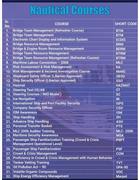
FRC FRB FFLB dg approved fast rescue boat course
FRC FRB FFLB dg approved fast rescue boat courseFRC FRB FFLB dg approved fast rescue boat course FRC FRB FFLB dg approved fast rescue boat course” Ocean Offshore Marine India Purpose Fast Rescue Craft / Boat course is designed as per IMO guidelines. It is to train personnel to operate FRC/FRB, which is mandatory for deployment in offshore field as per IOGP and on RO-RO passenger vessels as per IMO. Rig Contingency Plans will describe the actions, relevant for the type of vessel and equipment used, to take in the event of a calamity on board a vessel. One of the topics covered is the emergency procedure/ plan of rescue and treatment of casualties, including the use of FRB s. The emergency procedure will describe initial actions to take by the Master, FRB coxswain and crew before, during and after launching a FRB. Another topic will be the rescue, treatment of and transfer to safety of casualties after recovery. Crew needs to be trained accordingly and the procedure/plan will be revised when there are changes in legislation or best practices. Target Audience Fast Rescue Craft Marine crew working in offshore fields and those taking up jobs on RO-RO passenger ferry. This course is essential for personnel who are new to the offshore oil and gas industry that require this safety and emergency response training and assessment to work in an offshore cold or warm water environment. Ocean Offshore Marine India uses the latest equipments. We are the best institute to offer the #offshore courses in India. We offer all types of courses related to the offshore Industry. Contact for the offshore course booking of #BOSIET, #HUET #FOET, H2S #HLO #FRC #PSCRB, HFF, #HDFF #STCW 2010 Etc. #Now In India. Email- Oceanoffshore@pacific-ocean.com weoffshore@gmail.com Mob-8750141747 No Tags84 total views, 3 today
Along, Arunachal Pradesh2 hours
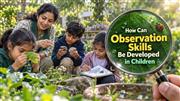
How Can Observation Skills Be Developed in Children?
How Can Observation Skills Be Developed in Children?Observation is one of the foundations of learning. Before children can explain, compare, investigate, or solve a problem, they first need to notice what is happening around them. In science, observation is particularly important because children learn by examining objects, living things, materials, movement, weather, and changes in their environment. A child observing how a seed grows, how a shadow changes, or how different materials respond to water is already beginning to think scientifically. Observation is more than simply looking. It involves noticing details, using the senses appropriately, identifying similarities and differences, recognizing patterns, recording information, and asking questions about what has been observed. How Can Observation Skills Be Developed in Children? • Encourage Children to Look Closely: Give children time to examine objects, plants, materials, pictures, or natural surroundings carefully. Ask them to notice details such as shape, size, texture, color, position, movement, and change. • Use Comparison Activities: Encourage children to compare two leaves, rocks, objects, animals, materials, or pictures. Identifying similarities and differences develops attention to detail and analytical thinking. • Explore Through the Senses: Safe sensory activities involving sight, sound, touch, and smell can help children collect information about objects and environments. Teachers should encourage children to describe exactly what they notice. • Ask Observation-Based Questions: Questions such as “What do you notice?”, “What has changed?”, “How are these different?”, and “What pattern can you see?” encourage children to examine evidence before giving an explanation. • Record and Communicate Observations: Children can draw pictures, maintain simple observation journals, create charts, take measurements, or describe findings verbally. Recording observations helps them organize and communicate information. • Use Nature and Everyday Experiences: Plants, insects, weather, shadows, water, soil, household materials, and changes in the environment provide meaningful opportunities for observation without requiring complex equipment. Age-Wise Learning Approach Ages 3–5 Young children can develop observation skills through sensory exploration, sorting, matching, nature walks, picture activities, and simple comparisons. Teachers can ask questions such as: “What color do you see?” “Which one is bigger?” “How does it feel?” “What changed?” Children can communicate their observations through words, gestures, drawings, or simple descriptions. Ages 6–8 Children can begin making more systematic observations. They can observe plant growth, weather, shadows, magnets, materials, water, insects, and changes over time. Simple observation tables, drawings, measurements, and science journals can help them record what they notice. Teachers can also encourage children to distinguish between what they actually observed and what they think might explain it. Ages 9–12 Older children can conduct structured observations as part of scientific investigations. They can measure changes, collect data, identify patterns, compare conditions, maintain detailed records, use simple scientific instruments, and analyze observations before drawing conclusions. At this stage, children can also evaluate whether their observations provide enough evidence to support an explanation. Why This Method is Effective Observation skills become stronger when children are encouraged to notice before they are asked to explain. For example, instead of immediately teaching children what happens during plant growth, a teacher can allow them to observe a growing plant over several days. Children might record: Day 1 → Seed planted Day 4 → Small shoot appears Day 7 → Stem becomes taller Day 10 → Leaves become larger The teacher can then ask: “What changes did you observe?” “What remained the same?” “What pattern do you notice?” “What evidence supports your answer?” “What would you like to observe next?” This creates a learning process: Observe → Notice → Compare → Record → Question → Analyze → Explain The child is therefore not simply receiving information but developing understanding from careful observation and evidence. The FEFDY Approach At FEFDY, science learning can encourage children to observe, question, explore, compare, investigate, record, and explain what they discover through meaningful learning experiences. Hands-on activities, environmental exploration, experiments, visual resources, real-life examples, and inquiry-based learning provide opportunities for children to observe scientific concepts directly rather than depend only on textbook explanations. Children can be encouraged to notice details, identify changes, recognize patterns, compare observations, record findings, and use what they observe as evidence when explaining scientific ideas. Through this learner-centered and experiential approach, FEFDY helps develop observation,
Chennai, Tamil Nadu1 days

Do you have anything to sell?

Sell your used goods online FOR FREE. It's easier than you think!

Post Free Ad Now